Look, I put off going to Pompeii for almost a year after moving to Naples. A year. I live forty minutes away by train and I kept finding excuses — too hot, too crowded, I'll go in October, maybe next week. My nonna would have smacked me. When I finally went, I stood in the Forum for about three minutes before admitting to myself that I'd been an idiot for waiting.
Pompeii is one of those places that genuinely shifts something in your brain. You walk down streets that people walked down in 79 AD. You see bread ovens. You see graffiti. You see the ruts in the road from cart wheels. Two thousand years, and the ruts are still there. It's not a museum behind glass — it's a city, open to the sky, and you're just standing in it.
So yes, you should go. Everyone goes, and everyone should. Here's how to do it without losing your mind or your wallet.
Getting There — The Circumvesuviana Experience
The Circumvesuviana is a commuter train that runs from Napoli Garibaldi (the station underneath Napoli Centrale, the main train station) to Sorrento, and it stops at Pompei Scavi–Villa dei Misteri, which is literally right at the entrance to the archaeological site. The ride takes about 35 minutes. A one-way ticket costs around 2.80 euros.
Now. I need to be honest with you about the Circumvesuviana.
This train is not the Frecciarossa. It's not even close. It runs on its own separate rail network, it's usually packed, there is no air conditioning on most cars, it's often late, and in summer the heat inside can be genuinely uncomfortable. The seats are hard plastic. People crowd the aisles. Pickpockets work the tourist-heavy routes, especially in July and August. Keep your bag in front of you, stay alert, and you'll be fine — but don't leave your phone hanging out of your back pocket like a free sample.
Go early. I mean it. The 8:00 or 8:30 train is ideal. By the time you arrive, the site opens at 9:00, and you'll have at least an hour or two before the tour bus crowds descend. By 11:00am the main streets inside Pompeii are shoulder-to-shoulder. By early morning, you can actually hear birds.
One more thing: make sure you get off at Pompei Scavi–Villa dei Misteri, not "Pompei" (the modern town stop, which is a different station on the same line). They're close-ish, but one drops you at the entrance and the other drops you in a random piazza where you'll spend fifteen minutes walking and wondering if you made a mistake. The announcement on the train is not always clear. Watch Google Maps or count stops.
What to See When You Can't See Everything
Pompeii covers 66 hectares. Sixty-six. That's bigger than most neighbourhoods in Naples. You cannot see it all in one visit, and you shouldn't try. People who attempt the full circuit end up sunburned, dehydrated, and unable to tell you what they actually saw because it all blurred together by hour four.
Here's what I'd prioritize, roughly in the order you'll encounter them from the Porta Marina entrance:
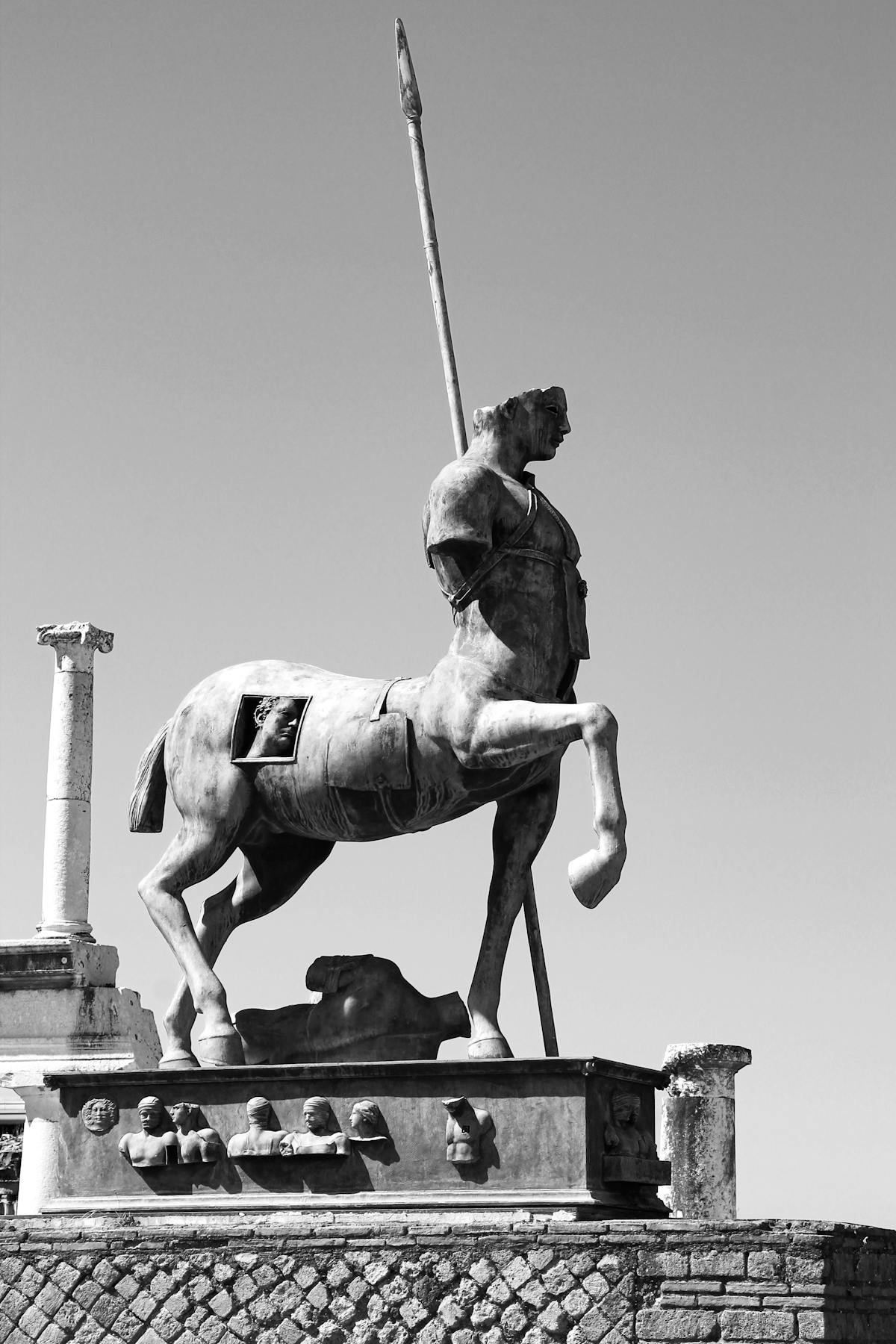
The Forum. This was the centre of civic life — temples, markets, government buildings, all framed by Vesuvius looming in the background. Stand in the middle and look north toward the volcano. That view will hit you. It hit me, and I'm a guy who gets emotional about ragù.
The Thermopolium of Vetutius Placidus (and the recently restored Thermopolium on Via delle Terme). These were ancient fast-food counters — stone counters with built-in terracotta jars where they served hot food and wine to people walking by. If that doesn't make you feel a weird kinship with people from two millennia ago, nothing will. Naples still has the same concept. We just call it pizza a portafoglio.
House of the Faun. One of the largest private residences in Pompeii, with the famous bronze dancing faun statue in the atrium (the one on-site is a replica; the original is in the Naples Archaeological Museum). The mosaic floors are spectacular.
Garden of the Fugitives. This is the one that stays with you. Plaster casts of people who died during the eruption, preserved in the positions they fell. A family huddled together. Someone curled on their side. It's quiet in there, usually. People tend to speak softly. You will too.
I stood in the Garden of the Fugitives for maybe ten minutes, not saying anything. A kid next to me, couldn't have been more than eight, turned to his mother and said "Were they scared?" and his mother just said "Yes." That was the whole conversation. It was enough.
Villa of the Mysteries. A bit of a walk from the main site, at the far northwest edge, but absolutely worth it. The frescoes inside — vivid reds and deep blues, depicting what's believed to be a Dionysian initiation ritual — are some of the best-preserved ancient paintings anywhere. The colours are almost impossible. You keep thinking they must have been restored, but no, that's the original pigment, protected by volcanic ash for nearly two thousand years.
Marco's take: What I'd skip
The Amphitheatre is fine but not essential on a first visit — it's at the far east end of the site and the walk there eats into time you could spend on the Forum area. The Lupanar (the ancient brothel) is famous but it's a tiny building with faded frescoes and a permanent queue of people giggling their way through. You've seen the photos online. That's pretty much the experience in person, except hotter and more crowded. See it if you pass by, but don't make it a destination.
Three to four hours is the sweet spot for a first visit. That gives you time to see the highlights, sit down and absorb some of it, and leave before the heat and the crowds wear you down completely. If you're the kind of person who reads every information panel (I respect that), budget four hours.
Tickets and Costs
Entry to Pompeii costs 18 euros for adults (as of early 2026). There are reduced rates for EU citizens aged 18–25, and free entry for under-18s. You can buy tickets online at pompeiisites.org to skip the ticket line, which I strongly recommend in high season.
| Item | Cost | Notes |
|---|---|---|
| Circumvesuviana (one way) | ~2.80 EUR | Napoli Garibaldi to Pompei Scavi |
| Circumvesuviana (return) | ~2.80 EUR | Same route back |
| Pompeii entry (adult) | 18.00 EUR | Reduced for EU 18–25 |
| Campania ArteCard (3-day) | ~25.00 EUR | Includes Pompeii + transport |
| Audio guide (optional) | ~8.00 EUR | Available at entrance |
| Water bottle (inside site) | 2.00–3.00 EUR | Bring your own if possible |
The Food Situation (Eat Before You Go)
I'm going to say this once, clearly, as someone who has built most of his adult identity around food: do not eat at Pompeii.
The cafeteria inside the archaeological site is the kind of place where a panino costs 7 euros and tastes like it was assembled by someone who has never actually eaten a panino. There's a snack bar near the Forum that sells reheated pizza slices and premade sandwiches wrapped in plastic. The restaurants lining the street outside the Porta Marina entrance are tourist traps of the highest order — the kind with laminated menus in seven languages and photos of the food, which is always a warning sign in Italy.
Here's what to do instead. Eat a proper breakfast in Naples before you catch the train. I mean a real Neapolitan breakfast: sfogliatella and a caffè at the bar, or a cornetto ripieno if you need something more substantial. If you're near the station, there are a handful of decent bars within a five-minute walk of Garibaldi. You will not starve in four hours. Bring a bottle of water (the site has a few water fountains, but they're scattered and sometimes not working) and maybe a piece of fruit or a tarallo in your bag.
When you get back to Naples, that's when you eat properly. You will be tired and hungry and a plate of pasta e patate or a proper pizza margherita in a place where the pizzaiolo actually cares about what they're doing will taste better than anything you've eaten in a month. The hunger is part of the experience. Use it.
Marco's take: The real Pompeii meal
My move: early train, see Pompeii, take the Circumvesuviana back to Naples around 1:00pm, and go straight to a trattoria in the centro storico for a late lunch. There's something about walking through an ancient city for four hours and then sitting down to eat spaghetti alle vongole in a city that's been feeding people for just as long. Naples and Pompeii are the same story, just at different points in the telling.
Practical Things Nobody Mentions
- Shoes. Wear actual closed-toe shoes with grip. The ancient streets are uneven volcanic stone, there are cobblestones with gaps, and some paths are gravel or packed earth. I've seen people in sandals and flip-flops. I've also seen those same people limping by hour two. This is not a metaphor.
- Sun. There is almost no shade inside Pompeii. The buildings don't have roofs anymore (volcano, remember). In summer, it's fully exposed walking for hours. Hat, sunscreen, water. Non-negotiable.
- Bags. There's a left-luggage area near the entrance if you're coming from the train station with a backpack. The site doesn't allow large bags inside.
- Maps. Grab the free paper map at the entrance. The site is large enough that Google Maps is useful too, but the paper map marks which buildings are currently open — not everything is accessible every day.
Combining with Vesuvius — Possible but Exhausting
People ask me about this constantly. "Can I do Pompeii and Vesuvius in one day?" Technically, yes. Practically, it depends on your tolerance for exhaustion and logistical headaches.
Here's the issue. Vesuvius is accessible from a bus stop near the Pompei Scavi train station (or from Ercolano Scavi, one stop earlier on the Circumvesuviana). The bus takes you partway up, then you hike the final 30 minutes to the crater. It's not a hard hike, but it's steep and loose gravel underfoot. Combined with three to four hours of walking at Pompeii, you're looking at a very full, very tiring day.
If you're determined to do both, here's the sequence that makes the most sense: take the early morning train, do Pompeii from 9:00 to 12:30 or 1:00, then catch the bus up to Vesuvius. You'll be back at the train station by late afternoon. You will be destroyed by evening. Eat a lot when you get back to Naples.
My honest recommendation: do them on separate days. Pompeii deserves your full attention and energy, and so does the view from the crater of Vesuvius. Cramming them together turns two remarkable experiences into one long slog. But I know some people only have one day, and if that's you, it can be done. Just bring more water than you think you need.
One day, I'll write a full piece about the Vesuvius hike. The view from the top — the entire Bay of Naples spread out below you, Capri in the distance, Naples sprawling along the coast — is one of the great views in Italy. And you're standing on the edge of a volcano that is, technically, only sleeping. That does something to your sense of scale.
But for now: go to Pompeii. Take the terrible, beautiful Circumvesuviana. Eat before you leave. Wear decent shoes. Stand in the Forum and look at Vesuvius and think about the fact that life continued then and continues now, in the same spot, under the same mountain. Then come back to Naples and eat like you mean it.
Andiamo.